README format
Audience. Daily user.
At a glance
Every item lives at projects/YYYY-MM/YYYY-MM-DD-slug/README.md. The file opens with a header (item metadata) followed by an H1 title and the body content.
From condash v2.16.0 onward, the canonical header shape is YAML frontmatter — a ----delimited block at the top of the file. The legacy bold-prose shape (**Key**: value lines under the H1) is also accepted indefinitely, so you do not have to migrate existing READMEs unless you want to.
| Field | YAML key | Bold-prose key | Required | Applies to | Notes |
|---|---|---|---|---|---|
| Date | date |
**Date** |
no | all | ISO YYYY-MM-DD. Defaults to the directory's date prefix when missing. |
| Kind | kind |
**Kind** |
no | all | project / incident / document. Defaults to project. |
| Status | status |
**Status** |
in practice | all | now / review / later / backlog / done. Omitting it is not an error — the parser defaults to backlog and condash projects validate reports a warning, not a failure. Unknown values are preserved verbatim (no silent rewrite), log a parser warning, and surface a !? <value> badge on the card. |
| Apps | apps (sequence) |
**Apps** |
no | all | YAML list of app names; legacy form is comma-separated, backtick-wrapped. Powers the per-app filter. |
| Branch | branch |
**Branch** |
no | projects | Git branch name. Hints the /pr skill + worktree isolation rules. |
| Base | base |
**Base** |
no | projects | Base branch for /pr. Defaults to origin/HEAD. |
| Parent | parent |
**Parent** |
no | all | Slug of the item this one spins off from. Drives the card's Part of banner and the parent's Subprojects rows. ↓ |
| Environment | environment |
**Environment** |
no | incidents | PROD / STAGING / DEV. |
| Severity | severity |
**Severity** |
no | incidents | low / medium / high. |
| Severity impact | severity_impact |
(combined into **Severity**) |
no | incidents | One-line user-visible impact. |
| Languages | languages |
**Languages** |
no | documents | Output language for deliverables. en / fr / … |
YAML keys are snake_case. Bold-prose keys are case-insensitive; values trimmed. Order does not matter in either shape. Unknown fields are silently ignored — safe to add your own.
Header shape — YAML frontmatter (canonical)
---
date: 2026-04-18
kind: project
status: now
apps:
  - helio
branch: feat/bench-harness
base: main
---

# Helio benchmark harness

## Goal
…
condash projects create emits this shape from v2.16.0 onward. To migrate existing bold-prose READMEs in the tree, run:
The verb is idempotent (already-YAML files are no-ops) and skips any README whose body has unexpected content between the meta block and the first ## heading — re-run after hand-editing those files.
Header shape — bold-prose (legacy, still accepted)
# Helio benchmark harness

**Date**: 2026-04-18
**Kind**: project
**Status**: now
**Apps**: `helio`
**Branch**: `feat/bench-harness`

## Goal
…
The parser scans every line between the title and the first ## heading. A line is treated as metadata if it matches **<Key>**: <value>. The first blank line is not a terminator — only the first ## heading is.
Both shapes feed the same parser output (src/main/parse.ts and src/shared/header.ts):
title— the H1 (frontmatter form: H1 below the closing---; bold-prose form: H1 at the top).date,kind,status(akapriority),apps,branch,base,parent,extra(severity, environment, …) — typed fields.summary— the complete, unbounded content of the first##section only. Wrapped source lines within a paragraph become spaces; one or more blank lines between paragraphs become a single blank line, which the project preview preserves.sections— every## <heading>with checkboxes under it (see conception convention).deliverables— every## Deliverableslink to a.pdf(see conception convention).
Examples
Project (YAML)
---
date: 2026-04-10
kind: project
status: now
apps:
  - notes.vcoeur.com
  - vcoeur.com
branch: feat/session-cookie-auth
base: main
---

# Migrate auth to session-cookie hybrid

## Goal

Complete intent for the project. The Goal may contain multiple paragraphs; all of
them appear in the project preview with paragraph separation preserved.

## Scope
…
## Steps
- [ ] Audit current session-cookie usage
- [~] Implement hybrid read path
- [x] Decide cookie attributes

## Timeline
- 2026-04-10 — Project created
Incident (YAML)
---
date: 2026-04-14
kind: incident
status: review
apps:
  - vcoeur.com
environment: PROD
severity: high
severity_impact: Login returns 500 under concurrent load
---

# Login returns 500 under concurrent load

## Description

The complete first H2 section is the summary shown in the project preview. It may
contain multiple paragraphs; the next H2 heading ends it.

## Timeline
- 2026-04-14 11:04 — Pager fires
- 2026-04-14 11:42 — Rollback to previous release
- 2026-04-14 14:20 — Root cause: connection pool exhaustion
environment and severity are incident-only in convention, but the parser will accept them on any kind. Nothing enforces the type split — the dashboard simply renders whatever it finds.
Document (YAML)
---
date: 2026-04-01
kind: document
status: review
apps:
  - notes.vcoeur.com
  - vcoeur.com
  - helio-web
languages:
  - fr
  - en
---

# GDPR audit — 2026 spring review

## Deliverables

- [Rapport technique](rapport-technique.pdf) — full French version with code references
- [Executive summary](summary-en.pdf) — one-page English abridgement
Status
Five values, in this exact order:
A README with no status: line at all is read as backlog — no badge, no error, just a warning from condash projects validate. That is the one case where the parser supplies a value; every other input is passed through untouched.
Anything outside the five known values is preserved verbatim — the parser does not rewrite it. Two side-effects keep typos from slipping past:
- The parser logs a
WARNINGwith the offending value and the item's path, e.g.unknown Status 'wip' in projects/2026-04/2026-04-17-foo/README.md. - The card renders a red warning badge carrying the offending value verbatim, with a tooltip showing the valid enum, and the item is filed under its own
?group. Sort order falls back to "after every known value" (perstatusOrderinsrc/shared/projects.ts), so the typo sits visibly at the end of the list until corrected. The badge disappears as soon as the README is fixed — the next poll cycle re-parses, finds a valid Status, and drops the badge.
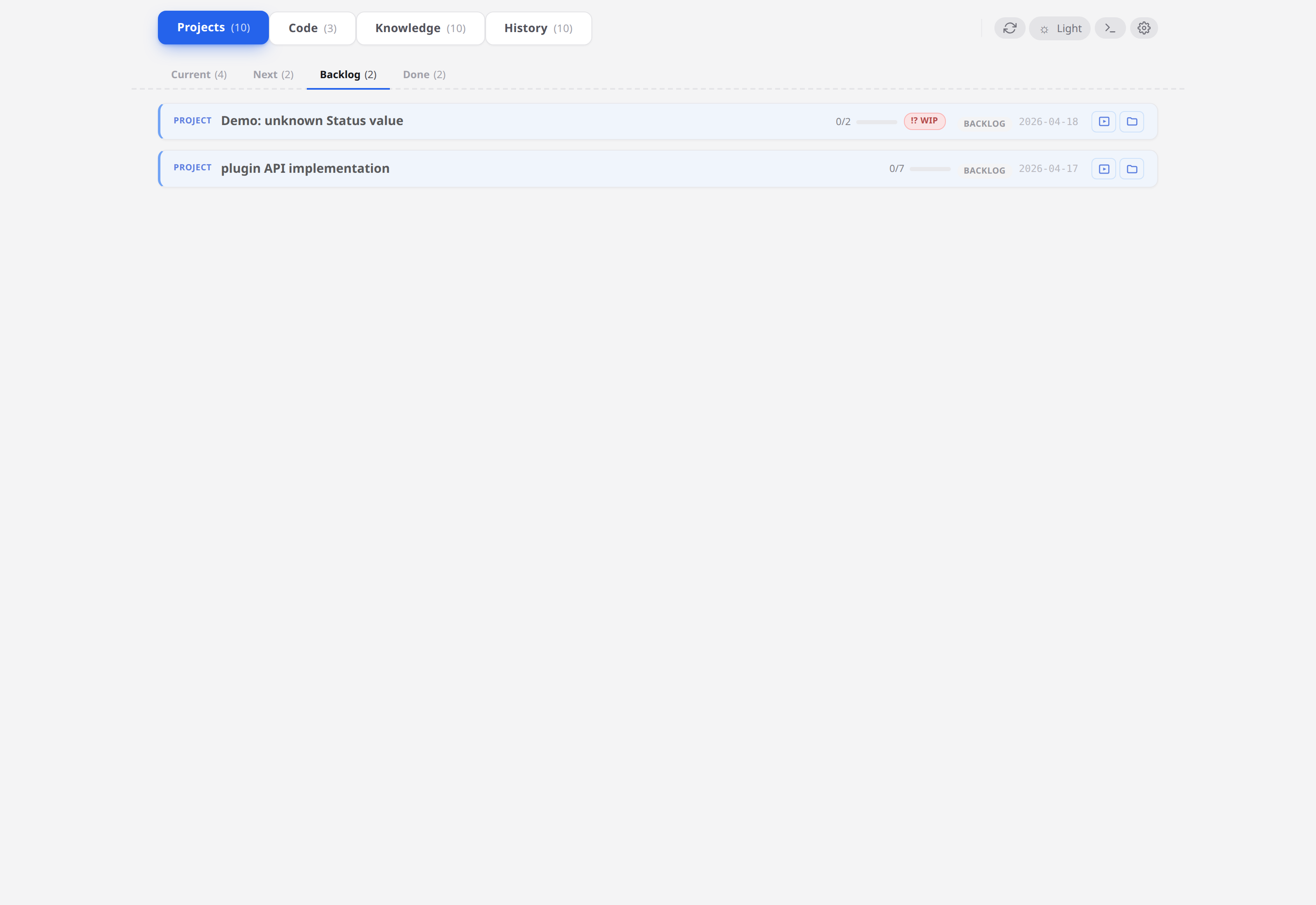
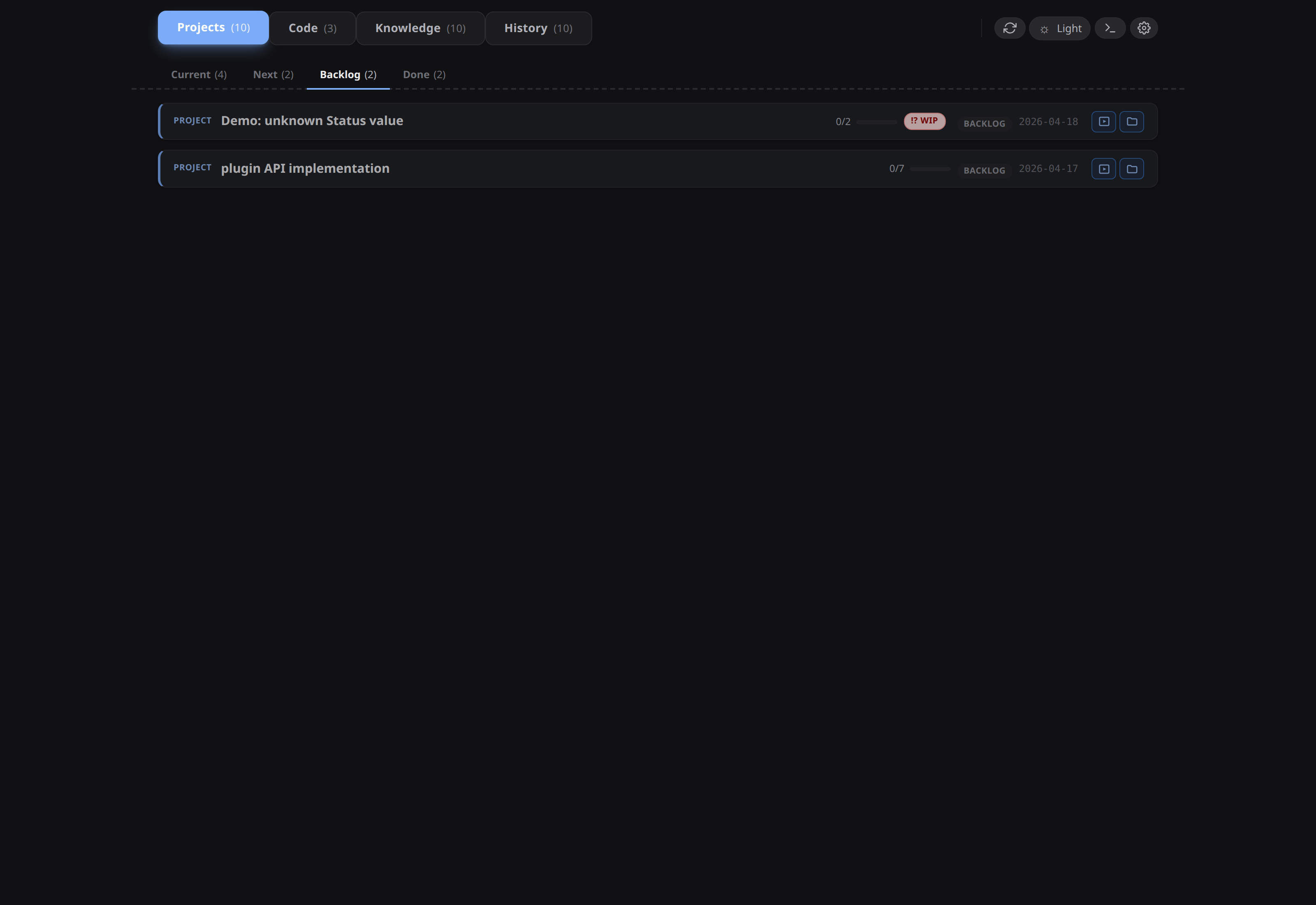
Without the badge, a typo like active would silently sit at the tail of the sort with no visible marker; with it, the item sticks out until corrected.
See conception convention for the status model and what each value means.
Apps
YAML form: a sequence of plain strings (no backticks, no parentheticals).
Bold-prose form: comma-separated, backtick-wrapped. Trailing (…) parentheticals are stripped, so `vcoeur.com` (frontend) becomes vcoeur.com.
Either way, the resulting list powers the dashboard's per-app filter chips.
Parent (subprojects)
A plan often spawns implementation items that deserve their own README, timeline, and branch. parent: records that edge — one line on the child, naming the plan it derives from:
---
date: 2026-07-18
kind: project
status: now
apps:
  - condash
branch: checkout-revamp-payments
parent: 2026-07-15-checkout-revamp
---
- The child declares; the parent stays untouched. The reverse edge — a parent's list of children — is derived by scanning the project list, never stored, so there is exactly one source of truth and no pair of fields to keep in sync.
- The value is a slug, in the canonical dated form (
YYYY-MM-DD-slug). Unlikeapps/branchit is not backtick-wrapped; the bold-prose parser accepts either form for hand-written files, but nothing emits bold-prose**Parent**. condash projects create --parent <slug>is the safe way to set it. The short form resolves against the tree and the canonical dated slug is what gets written, so the reference stays stable; an unknown or ambiguous slug exits 4 / 6 rather than writing a dangling reference.- List a plan's children with
condash projects list --parent <slug>. - A self-reference is a validation error (
parent '<slug>' refers to the item itself). Whether the slug resolves to a real item is checked at create time, not on every parse — a parent that was never created, or was renamed afterwards, is left dangling rather than rejected.
On the Projects pane the edge renders both ways. The child card grows a Part of ↑ banner carrying the parent's title and status pill; the parent card grows a Subprojects fold — a header with the child count, collapsed by default, that opens to one clickable row per child with its own status pill, ordered by status then slug (the open/closed state is remembered per parent, in the same browser-local store as the section collapse). Both banner and rows are buttons that open the referenced item. Every card in the chain — the root plan, any middle node, every leaf — shares one family colour on the card frame, hashed from the root's slug; it is the only colour a card frame ever carries, and standalone cards stay neutral. The frame itself also encodes the direction: a card with children keeps only a narrow solid left edge in the family colour, a card that declares a parent: keeps only a narrow dashed right edge, and a mid-tree node wears both at once — hierarchy is decoration only, so cards are never reordered, indented or nested to express it. A dangling parent: degrades to the raw slug as non-clickable text rather than disappearing; a card whose only relation is that dangling link takes no family colour — there is no second card for a hue to tie it to (a dangling link above a node that has children just makes that node the family's root).
Step markers
The ## Steps list uses five canonical markers, recognised by the parser
and round-tripped by every writer (CLI mutation verbs, GUI step-toggle,
the markdown editor):
- [ ]— todo. Not yet started.- [~]— doing. In flight.- [x]— done. Resolved successfully.- [!]— blocked. Surfacing a problem that needs attention; counts toward the milestone total but not toward resolved.- [-]— dropped. Resolved by removing the work; counts as resolved for the progress bar.
The canonical list lives in src/shared/types/project.ts (STEP_MARKERS). Any
marker outside this set is treated as plain prose by the parser.
Body conventions
Header fields only describe the item's metadata. The body (everything after the title, in YAML form; everything after the first ##, in bold-prose form) carries the content — goal, scope, steps, timeline, deliverables, notes. See:
- conception convention — the required and conventional
##sections. - Linking items with wikilinks —
[[slug]]/[[slug|label]]syntax inside the body and notes. - Deliverables and PDFs — the PDF link pattern the dashboard recognises.
What the parser never looks at
- TOML frontmatter — only
----delimited YAML is recognised. ##sections other thanSteps(plus any section carrying checkboxes),Deliverables, andTimeline— rendered verbatim as Markdown; not parsed for structure.notes/subdirectories — indexed as files under the card but never mined for metadata.- Any file in the item directory other than
README.md.